


Complaints Handling for Schools: Training Teams for Complex and AI-Assisted Complaints


Complaints handling for schools requires more than a compliant policy. Teams need practical skills to identify the real concern, assess student and organisational risk, communicate fairly, document decisions and choose the right response. Training should prepare frontline staff, managers and decision-makers to handle complex, sensitive and AI-assisted complaints consistently.
School complaints rarely involve one person, one issue or one clean version of events. A concern may involve a student, parents or carers, teachers, support staff, school leadership, a governing body and an external regulator. Each person may hold different information and expect a different response.
AI-assisted correspondence adds another layer. A complaint can now be lengthy, polished and framed in formal language without being clear about what happened or what outcome is sought. This article explains how schools and other regulated providers can build complaints handling as an organisational capability, rather than treating it as a policy exercise.
Key Takeaways
Effective school complaints handling depends on early clarity, fair communication and sound process selection. Policies provide important boundaries, but staff still need judgement and confidence. The strongest capability is shared across reception, teaching, management, governance, HR and complaints roles, so complainants do not receive different processes depending on who first reads the concern.
AI may change the length, tone and volume of complaints, but it does not replace human assessment.
Silence, delay and inconsistent messages can become part of the complaint.
Schools must distinguish service concerns, staff conduct, employment matters and safeguarding risks early.
Not every matter needs mediation, investigation or a formal complaints process.
Accurate records should show what was considered, what was decided and what happens next.
Scenario-based in-house training builds more consistent practice than abstract policy instruction.
Summary Table
School complaints should be triaged by issue, risk, people affected and required process, not by the polish or intensity of the correspondence. The table below summarises the core operational questions. It is a capability guide rather than jurisdiction-specific legal advice, and schools should apply their governing policies and obligations.
Capability area | Key question | Strong practice | Common risk |
Initial identification | What is the actual concern? | Separate events, impacts, requested outcomes and supporting material | Responding to every allegation without identifying the central issue |
Risk assessment | Does anything require immediate action? | Check student wellbeing, safety, safeguarding, privacy and evidence preservation | Treating all complaints as routine correspondence |
Communication | What does the complainant need to know now? | Acknowledge receipt, explain ownership and set the next step | Silence, vague assurances or promises that cannot be kept |
Classification | What type of matter is this? | Distinguish service, conduct, employment, discrimination and safeguarding issues | Sending the matter into the wrong pathway |
Process selection | What response fits the issue? | Consider a management decision, coaching, facilitation, investigation, conciliation or mediation | Defaulting to the organisation's most familiar process |
Documentation | Could another decision-maker understand the file? | Record material facts, communications, reasons, actions and review points | Keeping fragmented notes without a clear decision trail |
Team consistency | Would another staff member handle this similarly? | Use shared language, escalation criteria and decision structures | Different messages from frontline staff, managers and governance leaders |
Why School Complaints Are Becoming Harder to Manage

School complaints are becoming harder because they combine multiple stakeholders, sensitive subject matter, high expectations and overlapping responsibilities. AI can make submissions longer and more formal, but not necessarily more precise. Delayed or inconsistent responses then create a second problem: people begin reacting to the school's process as well as the original concern.
1. Multiple stakeholders create competing versions and needs
A parent may raise a concern about how a teacher handled an incident. The student may describe the event differently. The teacher may believe the concern questions their professionalism. A year-level coordinator may hold relevant context, while HR or a safeguarding lead may see risks that are not apparent in the initial email.
The issue is rarely just what happened. It may also involve:
the student's wellbeing and ability to participate in school
a parent's confidence that the school is listening
a staff member's right to a fair process
confidentiality and privacy boundaries
evidence held across emails, learning systems and staff notes
the authority of the person expected to make a decision
reporting, governance or regulatory obligations.
Good complaints handling keeps the person and the system in view. It considers role clarity, power, fairness, procedure and school culture, not only the personalities involved.
2. AI changes complaint presentation, not the need for judgement
AI-assisted complaints may include formal headings, policy references, legal language and long lists of requested remedies. That presentation can make a submission appear more authoritative or settled than the underlying evidence supports.
The correct response is not to dismiss polished correspondence as AI-generated. Nor should staff assume every cited rule is accurate. They should identify:
What events are alleged?
What impact is described?
What evidence is provided or available?
What outcome does the person want?
Which issues require immediate action?
Which claims need verification?
I developed and delivered a dedicated Navigating AI in Complaints and Dispute Resolution program in response to public-sector and business demand for practical guidance. The recurring challenge is not detecting whether AI was used. It is maintaining fairness, evidence integrity and manageable workloads when correspondence becomes easier to produce and harder to interpret.
3. Delay can deepen perceived unfairness
Consider a parent who raises a relatively contained concern about communication following a classroom incident. The email moves between administration, a teacher and a manager. Nobody confirms ownership because each person assumes someone else will reply.
By the time the school responds, the concern is no longer only about the incident. It is also about silence, uncertainty and perceived avoidance. Further emails copy senior leaders and demand a formal investigation.
Conflict is not a failure. It is often a signal that something important has not been properly understood. However, delay is not the same as care. Clarity is kind. A prompt acknowledgement and an honest explanation of the next step can prevent uncertainty becoming another source of conflict.
What Effective Complaints Handling Requires
Effective complaints handling requires early issue identification, active listening, impartial assessment, clear communication, reliable records and defined escalation pathways. A defensible response does not mean accepting every claim or requested outcome. It means showing that the concern was understood, relevant information was considered and a fair, authorised decision was made.
1. Use the Early Resolution Sequence
My Early Resolution Sequence gives teams a practical structure before formal escalation:
Clarify the issue. Separate the core concern from background, assumptions and repeated wording.
Understand what matters. Identify impacts, interests, risks and the outcome being sought.
Choose the right process. Decide whether the matter needs direct management, coaching, facilitation, investigation, conciliation or mediation.
Create structure. Define ownership, participants, scope, timeframes and communication points.
Support the conversation. Prepare staff to listen, explain boundaries and respond without becoming defensive.
Document the next step. Record the decision, responsibility, review point and information given to the complainant.
This sequence turns a vague tension into a manageable process. It also helps schools avoid treating every detailed email as a fully formed statement of the issues.
2. Listen actively without promising agreement
Active listening is not agreement. It is a disciplined attempt to understand what the person says happened, why it matters and what they believe should occur next.
Useful questions include:
"What is the central concern you would like us to address?"
"What impact has this had on the student or your engagement with the school?"
"What information do you think we may not yet have?"
"What outcome are you seeking?"
"Is there an immediate wellbeing or safety concern we need to consider?"
Staff should avoid premature assurances such as "we will fix this" or "that should never have happened" before the facts and authority are clear. A better response is calm, clear and fair: "I understand why that concerns you. I will explain who will assess it and what happens next."
3. Assess impartially and explain the scope
Impartial assessment requires staff to test information rather than defend the school or assume the complainant's interpretation is correct. It includes identifying disputed facts, available records, relevant policies, affected people and any conflicts of interest.
Scope matters. If the school will examine communication following an incident but not reopen a separate academic decision, it should say so. If an allegation has moved into a staff conduct process, privacy may limit what can be shared with a parent. Staff should explain that boundary without using confidentiality as a blanket reason for silence.
Procedural fairness does not require every person to receive every document. It does require a fair opportunity to respond where an adverse decision may rely on information about them, subject to applicable obligations and protections.
4. Build records that support continuity and review
A useful complaint file should allow an authorised colleague to understand:
what was raised and when
who owns the matter
whether immediate risks were assessed
what information was considered
who was contacted and what they were told
which process was selected and why
what decision was made
what reasons and review options were communicated.
Records should be factual and professional. Avoid speculative labels such as "difficult parent" or "unreasonable staff member". Record observable conduct, relevant communication and operational impact instead.
The Office of the Australian Information Commissioner explains that Australian Privacy Principle entities must manage personal information in line with the Australian Privacy Principles. Schools should apply the privacy framework relevant to their sector and jurisdiction when collecting, storing and disclosing complaint information.
5. Explain how to make a complaint
Government education pages in New South Wales, Victoria and Western Australia explain where parents, carers and students can raise concerns and what information to provide. A school's own guidance should be similarly accessible and should not assume complainants understand its internal structure.
Clear guidance should state:
available contact channels
who can help a student make a complaint
whether a support person or interpreter can be involved
the information that will help the school assess the concern
how urgent wellbeing or safety issues should be raised
what acknowledgement and updates the person can expect
when a matter may be referred to another role or process
available internal or external review avenues.
Accessibility is part of fairness. A process may be technically available but practically unusable if it relies on complex language, inaccessible forms or knowledge of school hierarchy.
Compliance Is the Baseline, Not the Full Capability
Compliance establishes minimum requirements, responsibilities and review pathways. It does not teach a staff member how to respond when a distressed parent arrives at reception, an employee disputes an allegation or an AI-assisted complaint contains numerous overlapping claims. Policies cannot replace judgement, communication skill, confidence or coordinated decision-making.
1. Policies do not apply themselves
A policy can state that complaints must be acknowledged, assessed and resolved fairly. It cannot resolve the operational questions that arise in a live interaction:
Is this a complaint, a request for information or an immediate safety report?
Who has authority to respond?
What can be said before facts are checked?
Does the complaint involve someone who would usually assess it?
Which information can be shared with a parent?
When should HR, governance or a safeguarding role become involved?
These are judgement questions. Staff need practice applying the policy while under pressure, not simply a presentation explaining what the policy says.
2. Consistency does not mean identical treatment
Fair systems apply consistent principles while responding to different needs and risks. A student may need developmentally appropriate communication. A person with disability may require an adjustment. A staff member facing an allegation may require a different process from a parent raising a service concern.
Neutrality and fairness are not identical. A school can communicate with empathy while remaining impartial. It can offer practical support without accepting disputed facts. It can also set reasonable communication boundaries while keeping a genuine concern open.
ISO 10002:2018 provides recognised guidance for complaints handling within organisations, including principles for planning, operation, maintenance and improvement. It is a useful reference point, but capability still depends on how people interpret and apply the system in context.
3. Avoid using compliance language as a shield
Statements such as "we followed policy" do not answer a complainant's practical questions. What did the school understand the concern to be? Who considered it? What information mattered? What was decided? What happens next?
A technically correct response can still damage confidence if it is vague, defensive or delivered after unexplained delay. Good process creates safety because people understand the structure, their role and the limits of the process.
This article does not provide jurisdiction-specific legal advice. Schools should confirm their obligations under applicable education, employment, child safety, privacy, discrimination and records frameworks.
Common Capability Gaps in School Complaints Teams
The most damaging capability gaps are usually defensive responses, unnecessary formalisation, silence, unclear ownership and poor issue classification. These gaps make manageable concerns harder. They also create inconsistent experiences across the school because frontline staff, managers, HR and governance roles may each understand the complaint pathway differently.
1. Responding defensively
Defensiveness often appears as correction before understanding. A staff member explains why the school acted properly before confirming the parent's central concern. The response may be factually accurate, but it communicates that the school's first priority is self-protection.
What helps is sequencing. First acknowledge the concern and its reported impact. Then clarify the issue. After that, explain what can be assessed and what information is needed.
2. Treating every complaint as a formal dispute
Formalisation can feel safe because it creates a defined process. It can also increase anxiety, delay and positional language when a simpler response would work.
A misunderstanding about an excursion notice may need a clear explanation and correction. A recurring communication breakdown may need facilitation. An allegation of serious misconduct may require an investigation. These matters should not enter the same pathway simply because someone used the word "complaint".
3. Allowing silence to become part of the complaint
Schools sometimes delay contact because the full answer is not ready. The complainant experiences that silence as avoidance or indifference.
An acknowledgement does not need to determine the outcome. It should confirm receipt, identify ownership where possible, flag any immediate action and provide the next communication point. If timing changes, communicate again before the expected update passes.
4. Unclear ownership
A complaint can touch several functions without anyone owning the whole process. A principal may address the parent, HR may manage staff implications and a safeguarding lead may assess risk. Unless one role coordinates these streams, messages can conflict.
Ownership should cover communication, not only decision authority. The complainant needs a clear contact, even where several authorised people are considering different aspects.
5. Failing to classify the issue
Schools need practical distinctions between:
a service or administrative concern
a teaching, assessment or communication concern
alleged staff conduct or misconduct
an employment or workplace issue
discrimination, harassment or victimisation
student wellbeing or safeguarding risk
privacy or information handling
a governance or regulatory matter.
Classification should remain open to revision. New information may change the pathway. The critical point is to make a reasoned initial assessment rather than letting the complaint's tone dictate the process.
Choosing the Right Response Through Process-Fit Distinctions

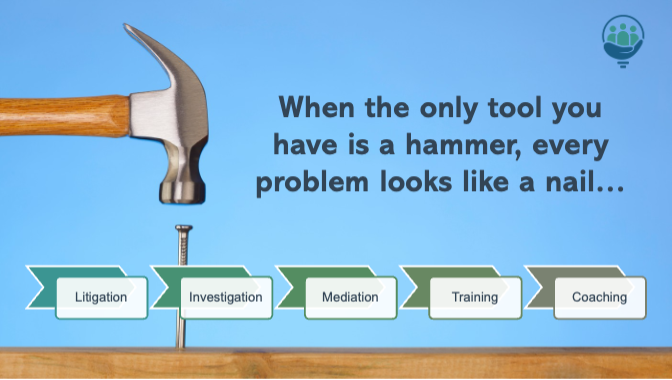
Not every school complaint needs mediation. The appropriate response may be a clearer management decision, conflict coaching, facilitation, investigation, conciliation or mediation. Process fit depends on the issue, risk, power, evidence, relationships and required authority. Choosing the right conversation, at the right time, in the right structure, beats process habit.
1. Start with distinctions, not preferred services
My Process-Fit Distinctions help organisations avoid defaulting to the process they know best:
Mediation vs investigation: mediation supports negotiated agreement, while investigation determines facts or findings within an authorised scope.
Conflict vs misconduct: relationship tension and disputed expectations require a different response from conduct that may breach standards.
Early resolution vs avoidance: a proportionate conversation is active resolution, but silence and indefinite deferral are not.
Neutrality vs fairness: neutral process management does not mean ignoring power, accessibility or participation needs.
Empathy vs agreement: staff can acknowledge impact without accepting an allegation or outcome.
Psychological safety vs comfort: a fair process may still involve difficult feedback, contested facts and firm boundaries.
This is where many complaint systems fail. The policy may contain several pathways, but staff lack a shared method for selecting among them.
2. When each response may fit
A clearer management decision may be appropriate when responsibility and authority are already clear. The problem may be ambiguity, inconsistent communication or reluctance to state a decision.
Conflict coaching can prepare an individual for a difficult conversation, help them separate interests from positions and improve their communication choices.
Facilitation can support a structured discussion where several people need clarity, coordination or shared working arrangements.
Investigation may be required where disputed facts, serious conduct or regulatory obligations call for formal evidence gathering and findings.
Conciliation can combine impartial process support with more active assistance to explore practical resolution options, depending on the governing framework.
Mediation is suitable where participants can negotiate, have sufficient authority and can participate safely in seeking an agreement. It should not be used to avoid a necessary management decision or investigation.
3. The hardest decision often comes before the process
My position is direct: process fit beats process habit. Sending every serious matter to mediation can be as unhelpful as sending every concern to investigation.
Before selecting a process, ask:
Is a factual finding required?
Is there an immediate safety or safeguarding issue?
Can the participants make or influence the required decision?
Is there a significant power imbalance?
Is the relationship ongoing?
Does someone need a binding management decision?
Could a direct conversation resolve the concern safely?
What documentation or review rights are required?
This analysis is an organisational capability. It cannot sit only with one complaints specialist because early process decisions are often made before that specialist becomes involved.
What In-House Complaints Handling Training Should Build
In-house complaints handling training should build shared judgement, language and decision structures across the school. The strongest programs use realistic scenarios over multiple days, tailored to policies, roles, escalation settings and recurring complaint patterns. Participants should practise difficult conversations and process selection, not merely listen to policy summaries.
1. Train the whole complaint pathway
A parent or student experiences one school, not separate internal functions. Training should therefore connect the roles of:
reception and administration staff receiving initial contact
teachers and year-level leaders responding to early concerns
principals and executives making management decisions
HR teams managing employment implications
wellbeing and safeguarding roles assessing risk
complaints specialists coordinating process
governance leaders overseeing serious or systemic matters.
Each group needs role-specific depth, but they also need a common operating language. A frontline employee should know what to capture and where to escalate. A manager should know how to define scope. A decision-maker should know how to give clear reasons without overclaiming certainty.
2. Use scenarios drawn from real patterns
Abstract examples produce abstract learning. Effective scenarios should reflect the organisation's actual environment, including:
a long AI-assisted complaint containing several distinct issues
a parent seeking information that cannot all be disclosed
a concern that begins as a service issue but raises staff conduct questions
an emotionally charged contact where the requested outcome is unclear
inconsistent messages from different school representatives
a safeguarding issue embedded in broader correspondence
a matter where mediation is proposed but investigation is more appropriate.
Participants should practise issue mapping, acknowledgement, questioning, risk escalation, process selection, written responses and documentation. Feedback should address both words and structure.
3. Multi-day delivery allows practice and correction
Complex complaints work cannot be built through information transfer alone. Teams need repeated practice, feedback and opportunities to apply the framework to increasingly difficult scenarios.
For a federal government department, I designed and delivered a five-day accredited mediation training program in-house. The whole cohort trained together within its statutory context rather than attending unrelated external courses. The lesson for schools is not that every program must be accredited. It is that shared practice inside the organisation's own framework creates more usable capability.
I have also delivered in-house communication and early-resolution training for an ombudsman office handling emotionally charged contacts. Its teams worked with shared language and structure based on their real case patterns, without staff leaving the building. That context matters because generic role-plays rarely reproduce the constraints facing regulated complaints teams.
4. Measure capability through work, not attendance
Attendance confirms that someone was present. It does not show whether they can handle a complaint.
Useful capability checks include whether participants can:
identify the core issue from a complex submission
separate allegation, evidence, impact and requested outcome
recognise immediate escalation triggers
explain scope and next steps clearly
choose a proportionate process and give reasons
write a factual, respectful file note
respond to emotion without becoming defensive
identify when they lack authority or need specialist advice.
Follow-up should reinforce learning through file review, coaching, facilitated debriefs or advanced scenarios. The goal is consistent practice in the next difficult conversation, not a certificate that sits in a folder.
5. Founder-led training for regulated environments
Shiv Martin Consulting's own business data reflects more than 15 years of dispute resolution practice, work with more than 50 government and business organisations, and more than 40 five-star Google reviews. The consultancy is Brisbane-based and works across Australia and New Zealand, supported by a multidisciplinary expert panel.
The flagship work is founder-led, in-house, multi-day training for government, enterprise and regulated teams. Programs can be tailored to a school's complaint policy, role structure, escalation settings and recurring case patterns. They can also connect complaint communication with facilitation, conflict coaching, mediation, conciliation and investigation decision points.
To discuss complaints handling training for a school, education organisation or regulated provider, arrange a confidential conversation with Shiv Martin Consulting. The first task is to understand the team's environment, not to force a standard course onto a complex system.
Frequently Asked Questions
How should a school respond to an AI-generated complaint?
Respond to the substance rather than trying to prove whether AI was used. Identify the alleged events, impacts, evidence, requested outcomes and immediate risks. Verify policy or legal references independently. If the submission contains many overlapping points, confirm the issues the school will assess and explain how unrelated matters will be handled.
How quickly should a school acknowledge a complaint?
A school should acknowledge a complaint within the timeframe set by its applicable policy or framework. Operationally, acknowledgement should occur before avoidable silence creates uncertainty. The message can confirm receipt, identify the responsible role, note any immediate action and state when the complainant can expect the next update.
Does every serious complaint require mediation?
No. Seriousness does not determine process by itself. A matter may require investigation, safeguarding action, conflict coaching, facilitation, conciliation or a clear management decision. Mediation fits where participants can negotiate safely and have authority to resolve relevant issues. It should not replace a required factual finding or management responsibility.
Who should receive complaints handling training in a school?
Training should include everyone who receives, assesses, escalates, communicates about or decides complaints. This usually spans frontline administration, teachers, middle leaders, principals, HR, wellbeing, safeguarding, complaints and governance roles. Content should vary by responsibility while maintaining shared language, classification and escalation practices across the organisation.
What information should a school ask for when someone makes a complaint?
Ask for the central concern, relevant events, people involved, impact, available supporting information and desired outcome. Also check for immediate safety or wellbeing issues. Do not create unnecessary barriers by requiring perfect terminology, extensive evidence or a particular form before the school will recognise and assess a genuine concern.
What makes a school complaint decision defensible?
A defensible decision has a clear scope, authorised decision-maker, fair process, relevant evidence and understandable reasons. The file should show what information was considered, how disputed material was treated, what decision was reached and what next steps or review options were communicated. Defensibility is about reasoned process, not merely a formal letter.
References
These references provide recognised guidance on complaints access, privacy and organisational complaint systems. Education requirements differ between jurisdictions and school sectors. Schools should use the framework applying to their organisation and obtain professional or legal advice where a complaint raises specific statutory, employment, safeguarding or regulatory obligations.
NSW Department of Education, Guide for parents, carers and students.
Victorian Government, School complaints.
Western Australian Department of Education, Complaints and concerns.
International Organization for Standardization, ISO 10002:2018 Quality management, Customer satisfaction, Guidelines for complaints handling in organizations.
Office of the Australian Information Commissioner, Australian Privacy Principles.
National Institute of Standards and Technology, AI Risk Management Framework.
Newsletter and blog
A monthly note from Shiv on conflict, complaints handling, leadership and dispute resolution practice. Reflective, practical, and written for people who work in and around conflict. No hype and no hard selling.
Subscribe to the monthly newsletter: Subscribe here
Shiv also writes regularly on workplace conflict, complaints, facilitated conversations and the changing landscape of dispute resolution.
Get new articles as they are published: Subscribe to the blog
How Shiv Martin Consulting Supports Teams
We provide:
Conflict resolution skills training in Brisbane, Australia and New Zealand wide and online to a range of global clients
Workplace mediation for early or unresolved conflict or tension
Leadership coaching to build communication and resolution skills
Team building and facilitation for groups that want to reconnect and move forward, without necessarily labelling the situation as conflict.
Whether your team is facing signs of friction or entrenched issues, we help you take a practical, people-smart approach to strengthening your culture.



.png)