


When to bring in an external workplace mediator
- Shiv Martin

- Aug 25
- 12 min read
Updated: Aug 26
Bring in an external workplace mediator when internal efforts have stalled, trust in the organisation's neutrality has weakened, or the dispute is affecting work, wellbeing or decision-making. External mediation is appropriate only when the parties can participate safely and the issue requires facilitated agreement rather than investigation, discipline or a management decision.

Workplace conflict rarely begins with a dramatic event. It usually starts with a concern that people manage around. As silence, delay and perceived unfairness accumulate, the process becomes part of the dispute.
The decision is not simply whether a conflict is serious. Leaders need to determine what the matter requires, whether internal resolution remains credible, and whether mediation is the right process at all.
Key takeaways
External mediation is useful when internal neutrality is doubted, previous conversations have stalled or organisational power differences are affecting participation.
Not every matter needs mediation. Alleged misconduct, safety risks and facts requiring formal findings may call for investigation or management action.
Delay is not the same as care. Unclear processes allow assumptions and defensive behaviour to harden.
A mediator manages the conversation and agreement process. They do not replace accountable organisational decision-making.
AI-generated complaints can increase detail and formality without increasing factual clarity, making careful process selection more important.
Preparation should address authority, confidentiality, support needs, documentation and what happens if no agreement is reached.
External workplace mediation at a glance
External mediation is one option within a broader workplace conflict system. The right choice depends on what must be decided, whether facts are contested, whether participation can be voluntary and meaningful, and whether the organisation can still provide a process that employees regard as calm, clear and fair.
Situation | Usually suitable process | Why |
Communication has broken down, but both people want a workable relationship | Mediation | A neutral practitioner can structure discussion and help the parties negotiate practical commitments |
A team has shared concerns about roles, workload or decision-making | Facilitation | The issue may be systemic rather than a dispute between two individuals |
One person needs help preparing for a difficult conversation | Conflict coaching | Individual preparation may resolve the matter without a joint process |
Serious misconduct or disputed facts require findings | Investigation | The organisation needs evidence assessment and a defensible finding, not negotiated agreement |
Expectations or reporting lines are unclear | Management decision | A manager may need to provide direction rather than outsource responsibility |
Internal efforts have stalled or neutrality is reasonably questioned | External mediation | Independence can restore confidence in the process, provided mediation otherwise fits |
What does an external workplace mediator do?

An external workplace mediator designs and facilitates a structured conversation between people in conflict. The mediator clarifies the issues, prepares participants, manages the meeting and records any agreed outcomes in an appropriate form. They remain independent of internal reporting relationships and do not impose a decision or determine who is right.
A capable mediation consultant begins before the joint meeting. Preparation commonly includes separate confidential discussions, assessment of participation risks, clarification of authority and agreement about the process.
During mediation, the practitioner helps participants move from fixed allegations towards identifiable concerns and workable requests. That does not mean minimising conduct or pushing people to compromise. Empathy is not agreement, and neutrality does not require indifference to fairness.
The mediator should also identify the limits of mediation. They cannot promise a particular outcome. They should not make factual findings while presenting themselves as neutral facilitators. They cannot guarantee confidentiality beyond the mediation agreement and any applicable legal requirements.
A workplace conflict resolution consultant may have a broader role. They might advise the commissioning organisation on process design, conflict systems, team capability or the boundary between mediation and investigation. Those advisory and neutral roles must be defined carefully. The same practitioner should not quietly move between them without informed agreement.
Good process creates safety because people understand the purpose, boundaries and next step. It does not make every conversation comfortable.
What signs show that internal resolution has run its course?
Internal resolution has usually run its course when repeated conversations reproduce the same positions, confidence in neutrality has fallen, or the dispute is spreading into performance, absence, complaints and team behaviour. The strongest trigger is not intensity alone. It is the combination of stalled progress, declining trust and ongoing organisational impact.
1. The same conversation keeps repeating
If managers have held several versions of the same conversation without clarifying issues or commitments, another informal meeting is unlikely to help. Repetition can deepen frustration because each participant arrives expecting not to be heard.
Before escalating, check whether the earlier conversations had a clear purpose. A vague instruction to "sort it out" is not a structured resolution attempt. Neither is relaying messages between employees for an extended period.
2. The manager is part of the dispute
Internal handling becomes difficult when the responsible manager is a participant, witness or subject of the complaint. Even a conscientious manager may not be seen as neutral. That perception matters because confidence in the process affects how openly people participate.
An external mediator can create separation from the reporting line. However, mediation should not be used to prevent legitimate scrutiny of a manager's conduct.
3. HR is no longer accepted as neutral
HR may have provided advice, documented concerns, supported performance processes or briefed executives. Those functions are legitimate, but they can make it difficult for HR to act as the accepted neutral facilitator later.
The question is not whether HR has behaved improperly. It is whether the parties can reasonably engage with an HR-led process without spending the meeting debating HR's role.
4. Power differences are shaping participation
Seniority, employment security, cultural expectations, disability, communication differences and access to organisational information can affect whether participation is meaningful. A skilled mediator can adjust preparation, sequencing, support arrangements and meeting structure.
Mediation does not erase power. If one participant cannot safely disagree or decline a proposal, the process may not be appropriate. External appointment alone does not solve that problem.
5. The conflict is affecting the wider system
The issue is rarely just the interpersonal exchange described in the first complaint. Role ambiguity, workload, inconsistent decisions, reporting structures and procedural delay may be maintaining the conflict.
Safe Work Australia identifies poor organisational justice, role clarity problems, poor support and workplace conflict among factors relevant to psychosocial risk. Employers should therefore consider both individual conversations and the design of work (Safe Work Australia).
6. Delay is becoming a new grievance
Clarity is kind. When employees do not know who is handling the matter, which process applies or when they will hear back, they fill the gap with assumptions. By the time a careful response arrives, people may be reacting to the silence as much as the original concern.
That does not mean rushing into mediation. It means making a prompt, reasoned process decision and communicating it clearly.
When is mediation the wrong process?
Mediation is the wrong process when the organisation must determine facts, respond to alleged misconduct, protect someone from immediate risk or make a non-negotiable operational decision. It is also unsuitable when participation is coerced, a party cannot negotiate safely, or leaders are using mediation to avoid their own responsibilities.

This is where my Process-Fit Distinctions matter:
Mediation versus investigation
Conflict versus misconduct
Early resolution versus avoidance
Neutrality versus fairness
Empathy versus agreement
Psychological safety versus comfort
1. When facts require formal findings
If an allegation could lead to disciplinary action, the organisation may need a procedurally fair investigation. Mediation is not designed to test evidence and reach findings on the balance of probabilities.
The Fair Work Act 2009 provides the federal legislative framework for workplace rights and protections. Organisations should obtain legal advice where the handling of allegations could affect those rights (Federal Register of Legislation).
It may be possible to mediate relationship or return-to-work issues after an investigation. The purposes must remain separate.
2. When conduct creates an immediate safety concern
If there is an immediate risk to health or safety, leaders must address that risk first. A joint meeting should not be treated as the default response.
Interim measures should be proportionate and should avoid prejudging disputed facts. They might concern reporting arrangements, communication channels or physical work arrangements. The appropriate response depends on the circumstances and applicable duties.
3. When reasonable management action is required
Not every disagreement about performance, rosters, responsibilities or standards is a mutual conflict. Sometimes a manager needs to set a clear expectation and explain the basis for it.
The Fair Work Ombudsman distinguishes workplace bullying from reasonable management action carried out in a reasonable manner. Mediation should not blur that distinction or make ordinary accountability appear optional (Fair Work Ombudsman).
4. When consent exists only on paper
An employee may agree to mediation because they believe refusal will damage their career. Good preparation tests whether the person understands the process, can seek advice, can identify alternatives and has genuine room to negotiate.
Participation can be encouraged. It should not be misrepresented as voluntary if refusal will carry consequences. Be honest about the organisation's expectations.
5. When leaders want the mediator to deliver a hidden decision
A mediator should not be commissioned to persuade an employee to accept an outcome already decided. If the organisation has made a decision, it should communicate and own that decision. A facilitated conversation may then help with implementation, but that is different from mediation.
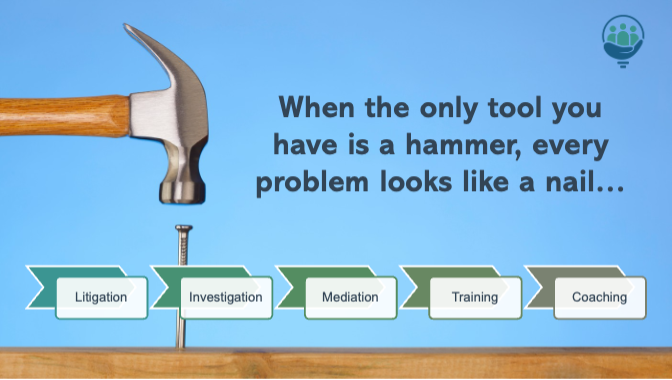
Not every matter needs the same process. Process fit beats process habit.
How do AI-generated complaints change the escalation pattern?
AI-generated complaints can become formal, lengthy and legally framed before the underlying issue has been clarified. Leaders should neither dismiss them as artificial nor treat every statement as verified evidence. The task is to identify the person's actual account, preserve relevant material and choose a process based on substance rather than presentation.
I developed the Navigating AI in Complaints and Dispute Resolution programme because public-sector and business teams were encountering this practical problem. The programme now runs publicly and as tailored in-house delivery for regulators and complaints teams.
The pattern I watch is simple. An employee experiences a difficult interaction. They ask an AI tool to draft a complaint. The output adds headings, legal terminology, inferred motives and broad remedies. The recipient responds defensively to the document's apparent severity. The dispute then expands before anyone has clarified what happened.
This creates several process risks:
A polished document may be mistaken for a reliable chronology.
Language generated by a tool may not reflect the employee's normal vocabulary or intended allegation.
Unsupported conclusions can become embedded through repetition.
Sensitive workplace information may have been entered into an external system.
Managers may focus on rebutting legal language instead of understanding the concern.
The volume of material can increase workload without improving evidentiary value.
What helps is a structured clarification conversation. Ask which statements are based on direct knowledge, which are interpretations, what source documents exist and what outcome the person is seeking. Do not begin by accusing the employee of dishonesty or improper AI use.
AI involvement does not automatically make mediation suitable. If the clarified complaint alleges conduct requiring findings, investigate. If the central problem is damaged communication and future working arrangements, mediation may fit. If the complaint reveals inconsistent roles or procedures, facilitation or a management decision may be more useful.
How should an organisation choose an external mediator?
Choose an external mediator by testing independence, process expertise, sector understanding and the ability to identify when mediation should not proceed. Relevant accreditation matters, but commissioning decisions should also examine preparation methods, management of power differences, documentation practices, legal boundaries and experience with comparable organisational settings.
1. Look beyond a generic mediator biography
Ask how the practitioner assesses suitability. A mediator who assumes every referral should proceed may be responding to the engagement rather than the organisation's needs.
Useful questions include:
How will you determine whether mediation is appropriate?
Who will receive suitability advice if it is not?
How do you manage support people, representatives and accessibility needs?
How do you separate confidential discussions from reportable safety concerns?
What will be documented, by whom and for what purpose?
How do you handle partial agreement or no agreement?
What experience do you have in our regulatory and workplace context?
The Australian Mediator and Dispute Resolution Accreditation Standards provide a national framework for mediator accreditation and practice (AMDRAS). Accreditation is an important starting point, not a complete procurement assessment.
2. Match expertise to the environment
Government departments, regulators and complaints bodies operate within statutory and procedural constraints. Enterprise workplaces have their own industrial instruments, policies and governance arrangements. The mediator must understand how these conditions affect authority and available outcomes.
In one federal government engagement, I designed and delivered a five-day accredited mediation training programme for tribunal-facing staff. The whole cohort learned together within its statutory setting rather than attending unrelated generic courses. The same principle applies when appointing a mediator: context changes the conversation.
Across more than 15 years in dispute resolution and work with more than 50 government and business organisations, I have found that technical skill matters most when it is adapted to the organisation's real work.
3. Define independence accurately
An external mediator is independent of the organisation's internal hierarchy, but the organisation usually commissions and pays for the process. That relationship should be disclosed rather than obscured.
The mediator's role, reporting boundary and communication channels should be agreed in writing. Participants need to know what information will return to the organisation. Avoid vague promises that "everything is confidential" when exceptions or reporting requirements apply.
How should HR prepare before making the referral?
HR should prepare by clarifying the issue, testing process fit, identifying decision-makers and explaining the proposed process to participants. The referral should define what is open for discussion, what is fixed, how confidentiality will operate, what support is available and what the organisation will do if mediation does not proceed.
My Early Resolution Sequence provides a practical structure:
Clarify the issue. Separate observable events, disputed facts, interpretations and system concerns.
Understand what matters. Identify interests, safety concerns, working requirements and desired outcomes.
Choose the right process. Compare mediation with coaching, facilitation, investigation and management action.
Create structure. Set roles, preparation steps, timing, authority and communication boundaries.
Support the conversation. Address accessibility, representation, power and emotional readiness.
Document the next step. Record agreements, responsibilities, review points and unresolved matters.
Do not send the mediator a large document bundle without explaining its status. Label allegations, responses, policies, contemporaneous records and contextual material. Make clear which documents have been shared with each participant.
Decide who can approve outcomes. A mediation can stall if participants identify a sensible operational solution but nobody present has authority to consider it.
Plan for all possible endings. Agreement is one outcome. Partial agreement, adjournment and no agreement are also legitimate outcomes. HR should know what process follows each one.
The Australian Human Rights Commission's Respect@Work resources reinforce the need for organisations to prevent and respond appropriately to workplace sexual harassment. Mediation must sit within that broader organisational responsibility, not replace it (Australian Human Rights Commission).
The real threshold is loss of process confidence
My view is that organisations often appoint an external mediator too late because they measure conflict by visible hostility. The more useful threshold is process confidence. Once people no longer believe the internal process can hear them fairly, another internal conversation may increase resistance even when the original issue remains manageable.
Conflict is not a failure. It often signals that something important has not been properly understood. The organisational mistake is allowing uncertainty to continue until every interaction is interpreted through suspicion.
I look at three connected questions:
Is the issue becoming clearer? If each conversation adds allegations without defining the core problem, the process is drifting.
Do participants still trust the structure? They do not need to expect their preferred outcome, but they must understand how decisions will be made.
Can the organisation act on any agreement? Mediation without operational follow-through creates another disappointment.
This is why early external involvement does not always mean immediate mediation. A short process-fit consultation may show that coaching, facilitation or a management decision is more appropriate. The value of independence is not simply having an outsider in the room. It is obtaining a disciplined view before positions harden.
The right conversation, at the right time, in the right structure, is more effective than defaulting to a familiar procedure.
Need an independent view on the next step?
If internal resolution has stalled, the first task is to decide which process fits. Shiv Martin Consulting supports organisations across Australia and New Zealand with mediation, facilitation, conflict coaching, consulting and tailored in-house capability programmes. To discuss the matter confidentially, visit the contact page at /contact.
Frequently asked questions
When should HR stop trying to resolve conflict internally?
HR should consider external support when internal conversations are repeating without progress, HR's neutrality is reasonably questioned, the manager is involved, power differences cannot be managed internally or the conflict is affecting the wider team. Before referring, HR should still determine whether mediation, investigation, coaching or management action fits.
Can an employer require employees to attend workplace mediation?
An employer may direct employees to participate in reasonable workplace processes, depending on the circumstances and applicable employment obligations. However, compelling attendance is not the same as obtaining meaningful consent to negotiate. The organisation should explain expectations honestly and obtain legal advice where refusal could lead to employment consequences.
Is external workplace mediation confidential?
Confidentiality depends on the mediation agreement, applicable law and any stated exceptions. Participants should be told what the mediator may report, how notes and agreements will be handled, and what happens if safety concerns or legally reportable information emerge. Avoid absolute assurances unless they are legally and practically accurate.
What happens if workplace mediation does not reach agreement?
The mediator should close the process clearly and report only what the agreed terms permit. The organisation may then use another appropriate process, such as a management decision, investigation, coaching or facilitated implementation planning. No agreement does not necessarily mean the mediation failed. It may clarify the issues and available options.
Should bullying or harassment allegations go to mediation?
Not automatically. Allegations requiring factual findings, safety controls or disciplinary decisions may need investigation or another formal response. Mediation may be considered for future working arrangements when participation is safe and informed, but it should not be used to suppress allegations or avoid the organisation's legal responsibilities.
References
These sources provide relevant Australian legal, safety and practice context. They should be read alongside the organisation's policies, industrial instruments and professional advice. No single publication determines whether mediation is suitable because process selection depends on the allegations, risks, participant needs and decisions the organisation must make.



.png)