


Expert Dispute Resolution Consulting for Organisations

Updated: Oct 8
Dispute resolution consulting helps organisations diagnose conflict, select the right process and build internal capability to handle difficult matters fairly. An expert consultant can provide conflict coaching, facilitation, mediation services, process advice and tailored training, while accounting for organisational roles, power, legislation, procedure and culture.
Conflict is not a failure. It is often a signal that something important has not been properly understood, addressed or communicated. Treating conflict as shameful tends to drive it underground, where silence and perceived unfairness compound the original issue.
Effective consulting brings the person and the system into view. This guide explains how that work should operate, when different processes are appropriate and what organisational decision-makers should expect from a capable provider.
Key takeaways
Effective dispute resolution depends on early clarity, sound process selection and practical implementation. Organisations should avoid treating mediation as the default response. The strongest engagements combine impartial diagnosis, structured conversations, clear governance and capability building tailored to the organisation's operational and regulatory context.
Conflict should be treated as information, not automatic evidence of dysfunction.
Not every matter needs the same process. Coaching, facilitation, mediation, investigation and management action serve different purposes.
Delay can increase uncertainty and perceived unfairness. Clarity is kind.
Consultants should examine workload, roles, power, procedure and culture, not just personalities.
In-house training programs are strongest when built around real work, legislation and recurring case patterns.
Success should be assessed through process quality, clearer decisions and usable capability, not promises that every relationship will be repaired.

Dispute resolution consulting at a glance
Dispute resolution consulting is broader than conducting a single mediation. It helps an organisation understand what is happening, decide how to respond and strengthen future practice. The appropriate service depends on the issue, the people involved, formal obligations and the outcome the organisation needs.
Option | Best used for | Consultant's contribution | Important limitation |
Conflict coaching | Preparing an individual for a difficult conversation or decision | Clarifies interests, language, risks and next steps | Does not create a shared process between parties |
Facilitation | Improving a team discussion, planning process or working relationship | Designs and guides a structured group conversation | Is not a substitute for determining serious allegations |
Mediation | Supporting parties to negotiate issues and possible agreements | Manages a voluntary, structured negotiation | May be unsuitable where fact-finding or decisive management action is required |
Conciliation | Resolving disputes within a statutory, regulatory or organisational framework | Combines structured resolution with relevant subject knowledge | Scope depends on the governing framework |
Investigation | Establishing facts and making findings where allegations require determination | Helps define issues and maintain procedural clarity | It is determinative, not a relationship-repair process |
In-house training | Building consistent capability across teams | Tailors language, simulations and tools to actual work | Generic delivery rarely addresses local process gaps |
What is dispute resolution consulting?
Dispute resolution consulting is expert advice and practical support for preventing, managing and resolving organisational conflict. It can cover early assessment, process design, conflict coaching, facilitation, mediation, conciliation and capability development. Its purpose is not to suppress disagreement, but to make difficult issues workable through a calm, clear and fair process.
The issue is rarely just the event described in the first email or complaint. A dispute may also involve unclear authority, inconsistent procedures, workload pressure, delayed communication or an earlier decision that was never properly explained.
A consultant should therefore resist premature labels. Calling something a personality clash can obscure a role problem. Calling it misconduct can formalise a disagreement before the facts justify that response. Calling mediation too early can place pressure on participants to negotiate an issue that management must decide.
The consultant's first task is to separate several questions:
What has happened, and what remains uncertain?
What matters to each participant?
Are there allegations that require investigation?
Does the organisation have a decision to make?
Is a facilitated conversation safe and appropriate?
What legal, industrial, policy or statutory framework applies?
What would a procedurally fair next step look like?
This analysis matters in Australian workplaces. The Fair Work Ombudsman's effective dispute resolution guidance emphasises clear procedures, timely handling and opportunities for employees to raise concerns. A consultant helps turn those principles into a process suited to the organisation and the matter.
Consulting is not a substitute for legal advice, executive accountability or a required statutory process. A competent consultant should identify those boundaries rather than claim ownership of every aspect of the dispute.
What role does a consultant play in conflict resolution?
A dispute resolution consultant diagnoses the matter, recommends an appropriate pathway and creates the structure needed for fair participation. Depending on the engagement, the consultant may coach leaders, facilitate discussions, provide mediation services, review complaint systems or design in-house training programs that improve the organisation's future response.
1. Clarifying the problem before selecting a process
Most workplace disputes arrive as competing narratives. Each narrative may contain valid information, assumptions and gaps. The consultant does not need to decide who is right during an initial assessment. The immediate task is to clarify the issues, risks, participants and decision-making authority.
I use the Early Resolution Sequence for matters that have not yet reached formal escalation:
Clarify the issue.
Understand what matters.
Choose the right process.
Create structure.
Support the conversation.
Document the next step.
This sequence prevents an organisation from jumping from vague tension to a formal intervention without understanding what the intervention must achieve. It also prevents early resolution from becoming avoidance. A matter has not been resolved merely because nobody has raised it again.

2. Creating the conditions for participation
Good process creates safety. That does not mean every conversation will feel comfortable. Psychological safety is not the same as comfort, and empathy is not the same as agreement.
Participants need to understand the purpose of the process, what information will be shared, who will make decisions and what happens afterwards. Where those boundaries remain vague, people can reasonably fear that an informal conversation will later be used against them or that mediation is replacing a promised investigation.
3. Keeping organisational responsibility visible
A consultant can provide neutrality within a process, but the organisation retains responsibility for management decisions, workplace safety and lawful action. Safe Work Australia identifies workplace conflict, poor support and poor organisational justice among psychosocial hazards. That makes conflict management more than an interpersonal concern.
Leaders must consider whether work design, reporting lines or inconsistent policy application contributed to the matter. Asking two employees to communicate better will not solve a system that gives them incompatible responsibilities.
Which dispute resolution process should an organisation choose?
The right process depends on whether the matter requires preparation, dialogue, negotiation, fact-finding or a management decision. Mediation is appropriate for some disputes, but it should not be the automatic response to serious or persistent conflict. Process fit beats process habit, particularly where allegations, power differences or statutory duties are involved.
I use Process-Fit Distinctions to test assumptions before recommending a pathway. The distinctions include mediation versus investigation, conflict versus misconduct, early resolution versus avoidance, neutrality versus fairness, empathy versus agreement, and psychological safety versus comfort.
Use coaching when someone needs preparation
Conflict coaching can help a manager, employee or complaints practitioner prepare for a difficult conversation. It is useful when the person needs to clarify their objective, regulate their response or communicate a decision without unnecessary escalation.
Coaching is not a way to place the entire burden on one participant. If the conflict is being sustained by unclear organisational expectations, the organisation must address those expectations directly.
Use facilitation when the group needs structure
Facilitation suits teams that need to discuss roles, working arrangements, service standards or recurring friction. The facilitator designs the conversation, keeps it focused and ensures different perspectives can be heard.
It can be particularly useful after organisational change or where unresolved issues are affecting meetings and collaboration. However, facilitation should not be used to collectively debate whether an individual committed serious misconduct.
Use mediation when negotiation is appropriate
Mediation supports parties to identify issues, understand interests and explore possible agreements. It can help where participants have sufficient authority and willingness to negotiate practical arrangements.
The Fair Work Commission explains that its dispute processes can include conciliation, mediation and, in some circumstances, arbitration. Organisational processes require the same discipline in distinguishing consensual resolution from determination.
Mediation may be inappropriate when facts must be formally established, a participant cannot negotiate safely, or management is attempting to outsource a decision it is responsible for making.
Use investigation or management action when a decision is required
Allegations involving serious conduct, safety or legal obligations may require investigation. Other matters simply require a manager to clarify a role, correct an unreasonable allocation or explain a decision.
Not every disagreement needs a third-party process. Sometimes the fairest response is a timely, well-reasoned management decision with an opportunity for affected people to be heard.
What are the benefits of expert dispute resolution consulting?
Expert consulting improves process selection, participation and organisational learning. It gives decision-makers an independent perspective while preserving management accountability. The practical benefit is not conflict-free work. It is a more consistent ability to identify issues early, respond proportionately and conduct difficult conversations without avoidable confusion or shame.
Earlier and more proportionate action
Most workplace conflict does not begin with a dramatic event. It begins with a small issue that everyone manages around. By the time it surfaces, people may be responding to silence, delay and perceived unfairness as much as the original concern.
Care should not be confused with slowness. Delay often leaves employees guessing about whether they have been heard, whether a process exists and whether a decision has already been made. Clarity is kind. Even when an immediate outcome is unavailable, the organisation can explain the next step, responsibility and expected communication.
Better separation of people, issues and systems
A sound assessment avoids reducing conflict to difficult personalities. It examines the interaction between individual behaviour and organisational conditions, including:
role clarity and competing accountabilities
workload and resource allocation
formal and informal power
procedural consistency
communication channels
cultural expectations
the quality of previous decisions.
This does not excuse harmful conduct. It produces a more accurate account of what the organisation needs to address.
Stronger internal capability
Consulting should leave useful capability behind. Leaders and complaints teams need language, structure and confidence they can use in their next difficult conversation.
According to Shiv Martin Consulting's own business records, the consultancy has worked with more than 50 government and business organisations, holds more than 40 five-star Google reviews and draws on more than 15 years of dispute resolution practice. Those figures provide context for the practice base. They do not remove the need to scope each engagement carefully.
Independent challenge without loss of accountability
Internal leaders may be too close to a matter or constrained by established assumptions. An external consultant can test the proposed process and identify gaps that insiders have normalised.
Independence should not become distance. Recommendations must still account for the organisation's legislation, industrial instruments, policies, operational pressures and decision-making structure.
What does an effective consulting engagement look like?
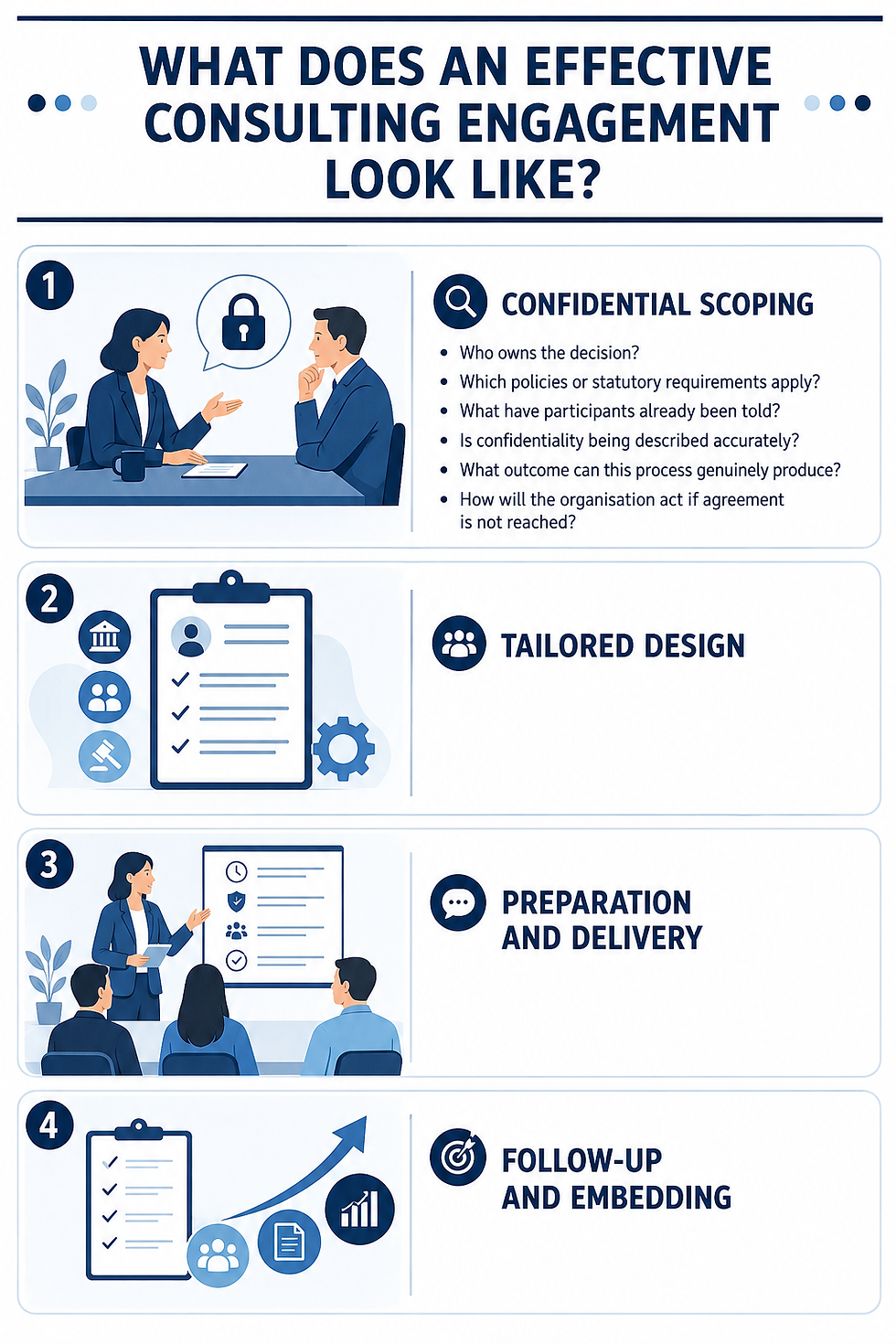
An effective engagement begins with confidential scoping, not a predetermined service or published package. The consultant should establish the issue, authority, risks, participants and intended outcome before proposing work. Delivery should then include clear boundaries, practical preparation, documented next steps and an agreed method for embedding learning.
1. Confidential scoping
The initial conversation should determine what is known, what is alleged and what the organisation has already promised. It should also identify urgent safety, legal or industrial issues requiring separate advice.
Useful scoping questions include:
Who owns the decision?
Which policies or statutory requirements apply?
What have participants already been told?
Is confidentiality being described accurately?
What outcome can this process genuinely produce?
How will the organisation act if agreement is not reached?
2. Tailored design
A government complaints team, enterprise HR function and tribunal-facing cohort do not need identical content. The process must reflect their authority, vocabulary, case patterns and obligations.
For training, this means using realistic scenarios and tools that fit the participants' work. For mediation or facilitation, it means designing intake, participation and documentation around the actual context rather than importing a generic template.
3. Preparation and delivery
Participants should know what to expect before entering the room. Preparation can clarify the consultant's role, the limits of confidentiality, the agenda and available support.
During delivery, the consultant must manage both substance and process. That includes identifying unclear language, checking assumptions, pacing the discussion and recording decisions accurately without flattening important differences.
4. Follow-up and embedding
A successful meeting can still fail if nobody owns the next step. Follow-up should confirm commitments, responsibilities and unresolved issues. Training engagements may also require practice sessions, manager reinforcement, templates or review of internal procedures.
The objective is not dependence on the consultant. It is a stronger organisational response after the engagement ends.
What do tailored dispute resolution outcomes look like in practice?

Successful dispute resolution work does not always end with a settlement. It may produce better process choices, shared language or consistent practice across a team. The following first-hand examples show why tailoring work to an organisation's statutory context and recurring conversations can be more valuable than generic external delivery.
1. Accredited mediation training for a federal department
A federal government department needed tribunal-facing staff trained in mediation. I designed and delivered a five-day accredited mediation training program in-house, tailored to the department's statutory context.
The whole cohort trained together inside its own regulatory frame rather than attending separate generic courses. That mattered because participants could practise with common terminology, comparable scenarios and a shared understanding of their authority.
The outcome was not presented as a promise that every future dispute would settle. The value was coherent capability across the cohort and direct application to the work participants were already doing.
2. Early-resolution training for an ombudsman office
An ombudsman office needed to support complaints teams handling emotionally charged contacts. I delivered communication and early-resolution training built around the office's real case patterns.
Staff gained shared language and structure for difficult conversations without leaving the building. The design kept the office's role, fairness obligations and operational realities visible. It did not treat challenging contact as a generic customer service problem.
3. Practical guidance on AI-generated complaints
Regulators and complaints teams are increasingly encountering AI-generated material that can complicate questions of fairness, evidence integrity and workload. In response to public-sector and business demand, I built the Navigating AI in Complaints and Dispute Resolution program.
The program now operates through public sessions and tailored in-house delivery. Its focus is practical: how teams assess material fairly, maintain sound evidence practices and respond to workload realities without dismissing a complaint merely because AI may have been used.
Why in-house capability often matters more than a one-off intervention
The strongest dispute resolution investment is often not a single facilitated conversation. It is a team that can recognise conflict early, select the right response and communicate clearly. In my experience, founder-led, in-house training creates more useful capability because the learning occurs inside the team's actual regulatory and operational frame.
Generic professional development can explain a model. It rarely addresses the sentences practitioners struggle to say, the points where an internal process stalls or the tension between empathy and authority.
Training should prepare participants for the next difficult conversation they will have at work. That requires more than slides. Effective in-house training programs should include:
scenarios based on the organisation's real work
structured practice with specific feedback
language for setting boundaries without unnecessary escalation
clear distinctions between listening, agreeing and deciding
tools for choosing between early resolution and formal action
attention to power, fairness and procedural expectations
follow-up that supports use after the training room.
This position is deliberately different from treating conflict capability as a collection of techniques. Skills matter, but they only work when participants understand their role and the limits of their authority.
For government and regulated organisations, shared training also allows teams to test how legislation, policy and service expectations interact. A complaints officer may need to show empathy without suggesting an outcome. A conciliator may need to remain impartial while addressing an unfair process. A manager may need to listen carefully and still make a decision.
These are Process-Fit Distinctions in practice. They cannot be resolved through a script alone.
How should organisations choose a dispute resolution consultant?
Choose a consultant who can diagnose before prescribing, explain process boundaries and adapt delivery to your operating environment. Relevant mediation, legal, conciliation, facilitation and training experience can be valuable, but credentials alone are insufficient. The consultant must also understand organisational power, procedural fairness and implementation.
Decision-makers should ask:
How will you assess whether mediation is appropriate?
How do you distinguish conflict from potential misconduct?
What information do participants receive before the process?
How do you account for power differences?
How will the work reflect our legislation and policies?
What will be documented, by whom and for what purpose?
How will capability be embedded after delivery?
What happens if the proposed process does not resolve the matter?
Be cautious when a provider guarantees resolution, assumes every conflict needs mediation or quotes a standard program before understanding the team. Outcomes depend on the issue, authority, willingness, safety and organisational follow-through.
Discuss your organisation's dispute resolution needs
Organisations should seek advice before uncertainty becomes the process. A confidential scoping conversation can clarify whether the need is consulting, coaching, facilitation, mediation, conciliation or tailored team training. It can also identify when legal advice, investigation or a direct management decision should take priority.
If your organisation is managing a current dispute, reviewing its complaint response or commissioning in-house training, contact Shiv Martin Consulting. The discussion can focus on your context, required capability and the right conversation, at the right time, in the right structure.
Frequently asked questions
What does a dispute resolution consultant do?
A dispute resolution consultant assesses conflict, recommends an appropriate process and supports fair implementation. Their work may include conflict coaching, facilitation, mediation services, conciliation, complaint process review and tailored training. They should also identify matters requiring investigation, legal advice or a clear management decision.
When should an organisation engage a dispute resolution consultant?
Engage a consultant when conflict is recurring, internal roles are unclear, trust in the proposed process is low or specialist capability is unavailable internally. Early advice can also help before launching mediation, investigation or a major training programme. The aim is to select the right process before positions harden.
Is mediation always the best response to workplace conflict?
No. Mediation suits matters where participants can safely negotiate issues and possible agreements. Coaching may help someone prepare, facilitation may support a team discussion, and investigation may be required for serious allegations. Some issues need a direct and procedurally fair management decision rather than mediation.
What should in-house dispute resolution training include?
In-house training should include realistic scenarios, structured practice, process-selection tools, feedback and language participants can use immediately. It should reflect the organisation's legislation, policy, authority and recurring case patterns. Abstract models without workplace application are unlikely to build consistent capability.
Can a consultant guarantee that a dispute will be resolved?
No credible consultant should guarantee settlement, restored trust or a particular finding. A consultant can design a fair process, support informed participation and improve clarity. Outcomes still depend on the facts, participant choices, organisational authority and whether management follows through on agreed or required actions.
How is dispute resolution consulting priced?
Pricing depends on scope, preparation, participant numbers, delivery format, travel, reporting and follow-up. A one-off coaching engagement differs substantially from multi-day in-house training or a complex organisational review. Shiv Martin Consulting scopes engagements through a confidential conversation rather than relying on published standard pricing.
References
The following Australian sources provide relevant guidance on workplace dispute processes, early resolution and psychosocial hazards. They support the general principles discussed above but do not replace legal advice, workplace policies or assessment of the specific statutory and industrial framework applying to an organisation.


.png)